

·4 min read
Google Wants to Send AI Compute to Space: Inside Its Blue Origin Partnership
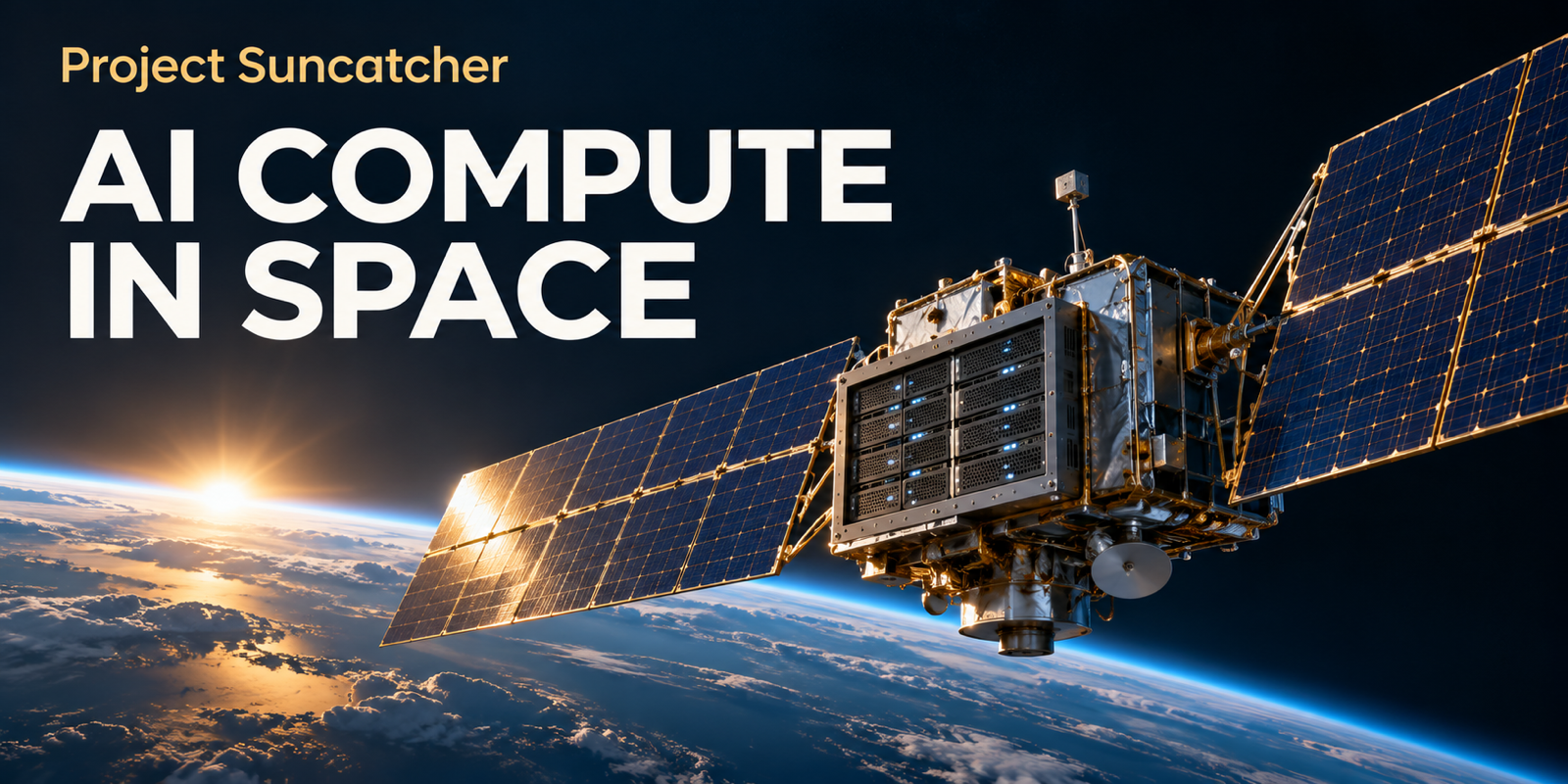
On November 19, 2026, Google announced a partnership with Blue Origin to launch Project Suncatcher satellites on a New Glenn heavy-lift rocket, targeting the first quarter of 2029. Google says each satellite will have roughly the compute capacity of one data-center rack. This is a planned mission to explore orbital AI infrastructure, not a completed commercial space data center. Google announcement
What is Project Suncatcher?
Project Suncatcher is Google’s long-term research effort to explore computing in space. Its concept places compute equipment such as TPUs on solar-powered satellites and investigates high-bandwidth optical links between them for coordinated machine-learning workloads. Google hopes to use solar power available in orbit, but scalable, reliable, and economical operation still needs experimental validation. Google Research system design
Blue Origin’s announced role is launch services. Google says New Glenn will carry out Suncatcher’s first dedicated heavy-lift launch, targeted for Q1 2029. The date is a target, not a completed mission. Google’s comparison of each satellite to one rack is an approximate capacity reference and cannot establish the performance or commercial scale of a full constellation.
What has happened so far?
Google says it launched a prototype satellite on October 1, 2026, then powered up its onboard TPUs and ran early machine-learning tests. On October 30, the company reported sending a prompt to an onboard Gemma 4 model and receiving a response. This demonstrates a limited orbital workflow, not proven long-term reliability or a working large-scale cluster. Prototype update
Google says further tests will examine thermal stress and radiation exposure and identifies two interconnected satellites in 2027 as a next target. Both the 2027 interconnection milestone and the 2029 New Glenn launch target can change as the research and mission plans develop.
Why consider AI compute in space?
As demand for model training and inference grows, the industry is looking for more computing and energy resources. Google’s research explores whether orbital solar power could support additional capacity beyond terrestrial facilities. Sun-synchronous orbits have particular lighting characteristics, but that does not guarantee continuous power to every satellite; generation depends on orbit, shadowing, and equipment design.
Workloads that process data generated in orbit or can tolerate communication delays may be worth studying. This is an inference from system characteristics, not a product Google has promised or a commercial service already demonstrated. Businesses and developers do not currently need to change an API or migrate workloads for this project.
What makes a space data center difficult?
Heat and radiation
In a vacuum, equipment cannot rely on air convection as it would on the ground; thermal conduction and radiative cooling need appropriate design. Space radiation can also affect electronics. Google identifies vacuum cooling, radiation, and launch vibration as engineering challenges; further prototype tests must supply evidence. Google’s engineering overview
Communication, maintenance, and cost
A coordinated satellite system needs high-bandwidth links, orbital coordination, and data exchange with the ground. Google has demonstrated optical communications on the ground, but a laboratory demonstration does not prove a cluster can operate reliably in orbit. Launch, deployment, maintenance, and equipment lifetime also matter. It is too early to conclude that orbital compute will be cheaper or greener than terrestrial data centers. Google Research design
What does this mean for AI?
The partnership shows that major technology companies are investigating compute beyond Earth and brings launch services, satellite engineering, and AI chips into the same research effort. Commercial-scale deployment remains unproven. Future mission reliability, communications performance, total cost, and real workload results will provide stronger evidence.
Businesses can continue monitoring compute supply and energy costs; orbital computing is not an established purchasing alternative today. This is an observation, not a forecast of Google’s commercial results.
Frequently asked questions
Has Google already sent an AI satellite to space?
Yes. Google reports that a prototype launched in October 2026 completed an orbital AI response test. The separate Blue Origin heavy-lift launch targeted for 2029 remains planned.
Is Blue Origin making Google’s AI chips?
The announcement confirms a New Glenn launch partnership; it does not say Blue Origin manufactures Google TPUs.
Will orbital computing replace ground data centers?
There is no such conclusion. Suncatcher is a research effort, and scalability, cost, and reliability remain to be established.
Is one rack equivalent to a whole data center?
No. Google compares the planned compute capacity of each satellite to roughly one data-center rack, not a whole facility.
Official sources
- Google and Blue Origin announcement, November 19, 2026.
- Prototype satellite response, October 30, 2026.
- Suncatcher engineering challenges.
- Google Research orbital AI system design.
Verified November 22, 2026. Launch targets and research plans can change.